Ichimonji Official Online Store in the Netherlands
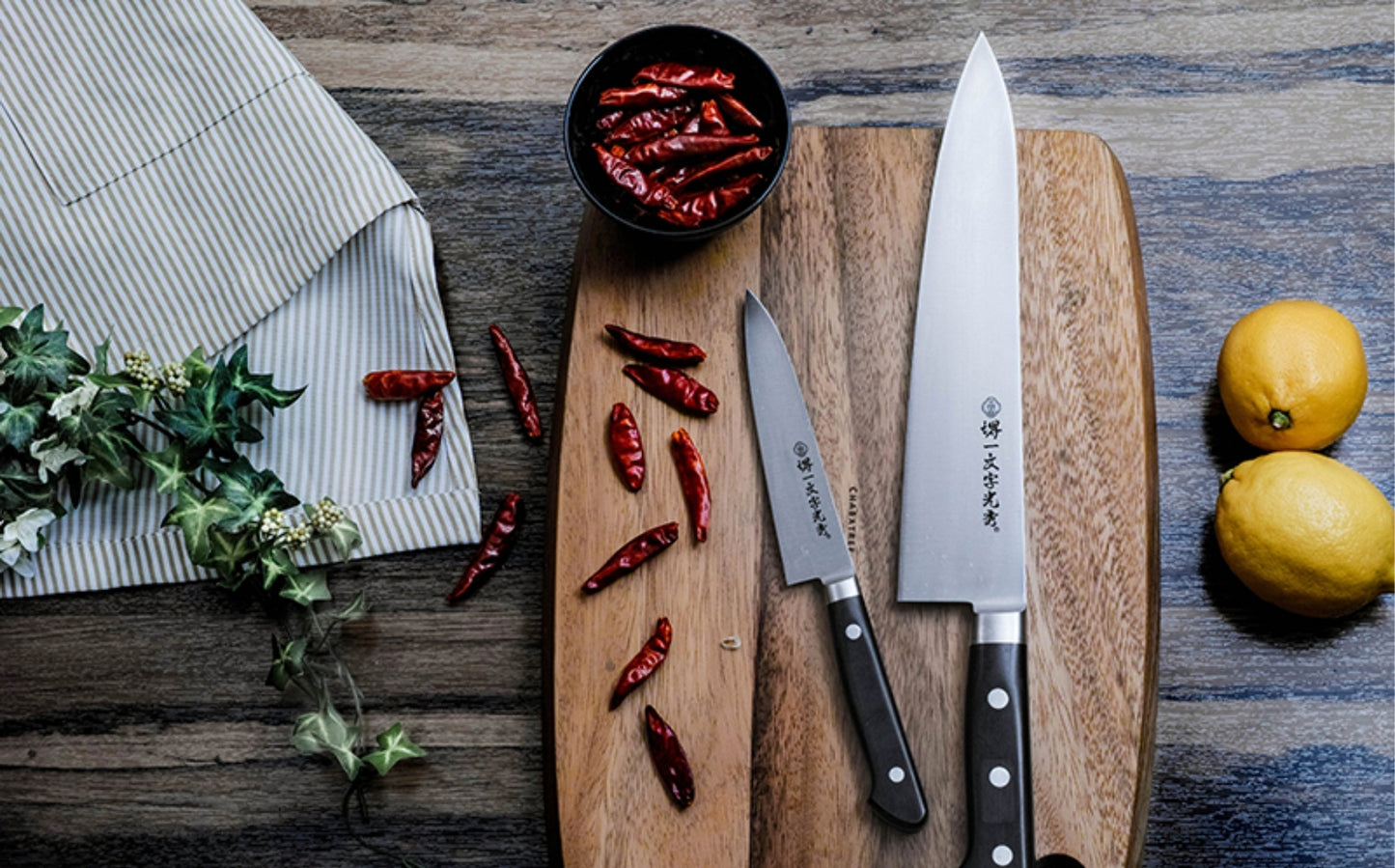
Special Carbon Steel Santoku Knife
Special Carbon Steel Santoku Knife
Couldn't load pickup availability
A knife series that maximizes the best qualities of both carbon steel and stainless steel.
While retaining the razor-sharp edge characteristic of carbon steel, the addition of a small amount of chromium and tungsten enhances both rust resistance and toughness. The steel used is classified as semi-stainless, meaning it resists rust spread while remaining easy to sharpen and offering high hardness — a favorite among experienced knife enthusiasts.
Santoku
The Santoku knife is an all-purpose kitchen knife commonly used in households, suitable for a wide range of tasks including cutting meat, vegetables, and fish.
Originally, the Western-style gyuto (chef’s knife) served as a multipurpose knife, but the Santoku was developed by combining the best features of Japan’s nakiri (vegetable knife) and the gyuto, resulting in a highly versatile and well-balanced design.
About the Steel
Carbon steel offers superior sharpness but rusts easily, while stainless steel resists rust but lacks the same edge performance.
The Special Carbon Steel Series is forged from a steel that blends carbon with small amounts of chromium and tungsten to bring out the strengths of both materials.
Although it may develop some rust, it does not spread easily, making maintenance simple.
Recommended for those who want a knife that combines excellent sharpness, durability, and ease of sharpening.
Full-Steel Construction
This knife is made using the zenkō method, forged entirely from a single piece of steel.
Unlike clad or Damascus methods that combine multiple layers, full-steel construction provides superior sharpness and edge performance.
However, because the steel is harder and more brittle, it demands advanced skill in heat treatment, straightening, and blade finishing.
Since it’s made from a single solid sheet of metal, it may look simple at first glance — but behind its understated appearance lies exceptional craftsmanship and professional-grade sharpness, making it a knife for true connoisseurs.
About Ichimonji
Sakai Ichimonji Mitsuhide is one of Japan’s most respected and historical knife brands. Its knives are trusted by leading chefs in Japan and around the world, including René Redzepi and Massimo Bottura.
Located in Sakai, the heart of Japan’s knife-making culture, Ichimonji has always designed its knives in close collaboration with working chefs. Their blades are true professional tools, built to support precision and long-term use in the kitchen.
Despite its long history, Ichimonji has never distributed its knives overseas.
This is because the brand is deeply committed to full customer support. They see each purchase not as a simple transaction but as the beginning of a long relationship with the user. Providing that level of care was difficult across borders, so for decades they focused entirely on their domestic customers in Japan.
Through mutual trust and technical understanding, Tohg Sharpening, led by master sharpener Yuske, who trained and worked at Ichimonji in Japan, became the first authorized distributor and sharpening partner in Europe.
Tohg Sharpening – Authorized Partner in Europe
Tohg Sharpening was founded to bring authentic Japanese knife sharpening to those who seek true craftsmanship.
Many sharpening services in Europe advertise “Japanese sharpening,” but most are self-taught, relying on online videos or general techniques. Authentic Japanese sharpening requires years of direct apprenticeship under a master. Without understanding the geometry of Japanese knives, these services often make edges thicker, reduce cutting performance, or even damage the blade.
At Tohg Sharpening, there are no compromises. Our work is not simply sharpening but a traditional process called tohging, a method that transforms the knife.
Each knife is thinned and hand-sharpened using at least eight whetstones, taking around one hour per blade, while most other services take only a few minutes.
Our process restores the true potential of high-quality knives.
Yuske, the master sharpener, trained directly under Ichimonji’s master sharpener and worked for the brand in Japan. With that background and close communication with the company, we can offer full support and ensure every knife is treated with the same care and standards as in Japan.
What Defines a Good Knife
Many Japanese knife brands popular in Europe are mass-produced or design-oriented, focusing on appearance rather than performance.
Brands such as Shun and Miyabi, and even some knives priced over €400, often simplify or omit key manufacturing steps. Their high price often reflects decorative handles or Damascus patterns, features that do not contribute to the knife’s actual cutting performance.
Material matters, but not as much as heat treatment
The essential factor in knife quality is not the material name but the heat treatment.
Even high-end materials like VG10 can perform poorly if the heat treatment is inadequate.
Quality knives vs poorly made knives
A high-quality blade holds its edge well, allows fine sharpening, and maintains the right balance between hardness and ease of resharpening.
Poorly made knives dull quickly, cannot be thinned properly, or have edges that crumble. These problems can occur with any steel type or price range.
For example, knives such as Nenox may cost over €600, yet Ichimonji’s professional lines, including VG10 Sword, Kirameki, G Line, and Special Carbon Steel Series, offer comparable or even better performance at significantly lower prices.
It can be difficult to judge a knife’s quality by appearance alone. That is why our goal is to provide authentic knives that combine true craftsmanship and fair pricing, supported by deep technical knowledge and years of experience under Japan’s top sharpeners.
Share